

Grace Rook

Starting farm layout from Gamers Decide, © ConcernedApe LLC
When I play Stardew Valley in the comfort of my own home, I am completely aware that the time could also be spent cultivating a small garden to bring a taste of virtual farming life into my reality. I choose to stick with my pixelated parsnips because growing things is hard, and I am deathly afraid of worms.
The dissonance between Stardew Valley’s virtual format and its back-to-nature messaging is not lost on me, nor do I imagine it is lost on many of its players. The game’s narrative has been analyzed within many scholarly lenses, and I am particularly interested in Lee Sutherland’s coinage of the term “desk-chair countryside” to describe the phenomenon of players experiencing rural life primarily through digital farming simulators (1156). A variety of individuals are drawn to this game for its cozy, comforting qualities, regardless of their experience with or interest in farming. Stardew Valley remains a cozy game because it omits non-cozy aspects of farm life, and specifically avoids any mention of death, which reinforces an idealistic view of rural living.
Digital Agrarianism
Agrarianism generally refers to an idealization of agriculture as a way of life and can be split off into classical agrarianism and critical agrarianism. As Lee-Ann Sutherland defines it in her article, titled “Virtualizing the ‘good life’: reworking narratives of agrarianism and the rural idyll in a computer game,” classical agrarianism incorporates “historic ideals of the positive role of agriculture in society,” wherein farming is viewed as inherently more moral than other ways of life, and the hard work of the farmer constitutes the backbone of society and the economy (1157). Conversely, critical agrarianism is a counter-culture movement. It similarly values farming and ways of living that are closely connected with nature, but it does so in response to more industrialized forms of food production or environmental harm caused by large agri-business structures. In other words, it favors smaller family-style farms to both urban life and large-scale farming methods.
Eric Barone, Stardew Valley’s developer, incorporates aspects of both forms of agrarianism, but always uses them to reinforce an idealistic and escapist view of rural living. The game’s opening encourages the player to return to farm life as an escape from their miserable office job, which frames rural life as more fulfilling than desk work. The game frames JojaMart, a supermarket chain that the player leaves to become a farmer, as detrimental to the community of Pelican Town by putting it in competition with Pierre, a local grocer, and framing the company as a threat to the town’s Community Center, which JojaMart wants to buy. This delineation between the industrial food distributor and the local community reflects the small-scale farming orientation of critical agrarianism, and the moral connotations of JojaMart as a villainous entity align with a view of farming as virtuous found within classical agrarianism. Notably, the narrative focuses criticism outwards onto the supermarket chain. The game does not cast any comparable criticism on the potential environmental harm or other problems which may arise even within rural agricultural structures. As Sutherland points out, the developer Barone may simply “not be aware or concerned about the processes and negative externalities of industrialized agricultural production” (1169). Barone’s Stardew Valley was inspired by Harvest Moon, another farming simulator, and not from lived farming experience, so this omission may reflect his unfamiliarity with farm life. In a review of Stardew Valley, gaming journalist Phil Savage remarks, “I did live in the countryside. It was boring and full of jerks and cow shit” (82). Barone’s idealistic countryside rings as a sanitized misrepresentation of rural living with many players who have that experience.
Unkillable Farmers Who Heal in Their Sleep
The most blatant censorship of farm life in Stardew Valley is its avoidance of death. The player’s avatar simply cannot die. Instead, the avatar can become exhausted or hurt to a degree that they pass out. They awake back in their home, perhaps with items or money missing as a penalty. The game’s stakes are significantly lowered by the absence of death as a threat, which does enhance the game’s appeal in terms of relaxation. However, the absence of death or severe, lasting injury as a possibility in a game where one plays as a farmer is at odds with the dangers of agricultural work, not to mention completely unrealistic in a game that requires mining labor. According to the CDC, in 2022, workers in the agriculture, forestry, fishing and hunting industries suffered fatal injury rates of 18.6 deaths per 100,000 full-time equivalents (FTE), whereas the average rate for all U.S. industries was only 3.7 deaths per 100,000 FTE. Additionally, between 2021 and 2022, 21,020 injuries in agricultural production were reported as requiring days off from work, but injuries in this industry are known to be underreported. This death and injury data reflects the intensive labor and powerful machinery involved in many approaches to farming. Accidents can and do happen to agricultural workers, and in an industry where such harm goes underreported, Barone’s downplay of such dangers in his game mechanics reinforces a lack of awareness and attention on farming hazards. The coziness of Stardew Valley comes at the cost of an erasure of the physical dangers of farm labor.
No One Eats Bacon in Pelican Town
Barone’s censorship of death extends to animals, as his vegetarianism is reflected in the game. A 2016 interview article by Jesse Singal links Barone’s vegetarianism to his decision not to include the ability to butcher animals in game, as he “didn’t want to have that sort of violence” in the game (Singal). The absence of animal death contributes to Stardew Valley’s ability to remain a cozy game, as players do not need to decide for themselves the ethics of raising animals for their meat. Even if the players themselves are not meat-eaters, they do not have to consider the source of their diets, even within this farming simulator. However, as Erik van Ooijen points out in his article “The Killability of Fish in The Sims 3: Pets and and Stardew Valley,” animal death is not absent from the game. Killing fish is not only an option, but extremely encouraged by the game’s lucrative fishing mechanics. Seafood is not the only killable living creature. In addition to catching fish, crabs, and squids, players are encouraged to kill monsters. Monsters include sundry and assorted ghouls, but they also include bugs, grubs, and bats, and this subclass of animal death is rewarded through loot drops and in-game achievements (Ooijen 178-179). Because of these game mechanics and reward systems, animal violence is “not only allowed, but encouraged” (Ooijen 179). It seems that animal butchery is not an option in the game only where livestock are concerned, which players raise, care for, and grow attached to. For lesser animals that the player does not care for, violence is welcome. This quandary over animal ethics is a prime example of limits of idealistic agrarianism. To preserve a sanitized, charming countryside, Barone censors violence where it upsets the player and includes it where it will not cause psychological distress. This selective representation of livestock-based agriculture reinforces an outside view of farm life that ignores the realities of meat and dairy production.
When Children Fly the Nest
Is it better to kill your children or turn them into doves? I wouldn’t stress over your answer to that question, as you will likely never be faced with such a choice. At least in the world of Stardew Valley, you do not have the option to kill your children. Your only option is to transform them into doves. This feature is one of the most bizarre features of the game, wherein a player can offer a Prismatic Shard to the Dark Shrine of Selfishness to turn their children into doves and permanently remove them from the game.
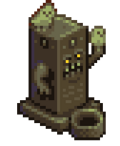
Dark Shrine of Selfishness from the Stardew Wiki, © ConcernedApe LLC
While it makes sense that a player may wish to remove a child from the game to improve gameplay without restarting their world, this feature is a symbolically fraught way of providing players a way out of parenthood. For example, the option to rapidly age up a child and send them into the world would accomplish the same goal without introducing thinly veiled infanticide to the game. This constitutes another contradiction to Barone’s stated desire to keep the game nonviolent, although the game does cast moral judgement on characters who use this feature. Characters may be haunted by a doll or receive spooky telephone calls after transforming their children. The ghostly consequences of getting rid of children indicate that such a practice is frowned upon, and the name “Dark Shrine of Selfishness” specifically frames the action as self-serving. Agrarianism surfaces here by valuing family over a selfish desire to get rid of children. Critical agrarianism values family-style farms over larger farming structures, and so while the game presents players with the option to shrink their families, it punishes them for doing so. The game mechanics encourage a family farming structure where parents raise children, reinforcing the wholesome view of farm life that attracts both agrarians and cozy gamers.
The Cost of Coziness
While it obscures the realities of rural living, Stardew Valley’s sanitization of human and animal death culminates in a very cozy, enjoyable playing experience. When I settle in for a gaming session after a long day, I don’t necessarily want to think about combine-related injuries or the ethics of the meat production industry. Barone’s creation of an idyllic, peaceful world meets most cozy gamers’ desire to escape the violence and uncomfortable ethical questions that accompany real life. However, Stardew Valley does not exist in a vacuum. It constitutes a “desk-chair countryside,” where many players develop their own understanding of rural life. Players are aware that they are playing a fictional game, and Barone does not encourage them to take the game literally, but for players who live in urban environments, this game may still influence the way that they view agricultural life. If real issues regarding workers’ safety, animal health and well-being in the meat production industry, and questions regarding what family models are encouraged by “back-to-the-land” agrarian movements are ignored in the game, they are likely also ignored by many players for whom Stardew Valley is a primary touchstone for farm life. A byproduct of this game’s coziness is that it encourages players to view rural life, and death, uncritically. This doesn’t mean players have to abandon their peaceful Pelican Town, but it does mean they may want to engage with more honest accounts of agricultural life.