

Terra Hoover
This article is dedicated to Wayne June (1954-2025), voice of the Narrator in Darkest Dungeon 1 and 2, rest in peace.
What defines a “cozy” game? That’s a pretty loaded question, and you’ll be hard-pressed to find the same answer from two different people. Some examples people may usually have include an overall cheery vibe and relaxed gameplay to match their cozy title, games like Stardew Valley or Unpacking. Some may simply use “cozy” to describe their personal comfort games that require a bit more involved gameplay, such as Hollow Knight or Celeste. Between all of these games, the only through-line seems to be that they’re indies, but why are there so few triple-A cozy games?
Well, one reason might be the lack of an industry standard. As established, the market for cozy games is quite varied but that can make it hard when you’re a company trying to market to a specific audience. Most big-budget game releases use a quick and easy sell for fans of a genre using other games in that genre; Apex Legends, for example, was marketed as “Overwatch meets Fortnite” by the loads of creators that EA had sponsored to promote it. How would you do that when marketing a new cozy game? If it’s sold as “Hollow Knight meets Celeste,” there’s no guarantee that the game is going to be considered as “cozy” because of how mechanical the two are—which means potentially losing your core audience. If it’s sold as “Stardew Valley meets Unpacking,” well that’s just the Sims. So with no clear formula that guarantees a cozy game is going to be a commercial success, how would you even begin to design one?
Looking through the cozy tag in Steam, a few accompanying tags seem to consistently reappear: Simulation, Puzzle, Exploration, Single Player, and more. Looking at all these tags, it seems like the similarities are more in the style of gameplay as opposed to a singular genre. “Cozy” games seem to always feature player-driven pacing. What it essentially boils down to is that you are always in charge of how fast the game progresses, both in terms of the game’s overall pacing and those more specific, isolated moments of gameplay.
For some personal background, I never really considered myself much of a cozy gamer. The closest most games in my library come to having player-driven pacing are turn-based games like Baldur’s Gate 3, which still has the macro-element of any choice you make having an irrevocable change on the game’s narrative (Unless you save scum. No shame, I’ve done it once or twice as well). There are cozy games I enjoy—Tiny Glade is one I personally recommend— but there never really was a cozy game that sat in my top five in terms of playtime for a week, month, or year, even. That was until I started to think harder about the idea of player-driven pacing and I realised there was a game that I had played a lot of. A turn-based RPG, where every playthrough was short, didn’t proceed on its own, and only furthered you toward your end goal.
Darkest Dungeon 2: Cozy Confessions

From the Darkest Dungeon website, © Red Hook Studios, 2021
Looking at the world of Darkest Dungeon 2, it’s anything but cozy: madness has consumed the world, leaving in its wake doomsday cultists and monsters beyond description by any human tongue. The last bit of hope (figuratively and literally) sits atop your carriage, burning bright but slowly fading as you must give hope to get it. Journeying throughout the world on old beaten paths, you’ll cross kingdoms burned to cinders, putrid bogs of bile, and forests hiding undead behind their branches, all to reach your final destination: The Mountain.
For many, I would hope most, a medieval H.P Lovecraft novella sounds like the farthest from the definition of “cozy” as far as games go. While I agree on most accounts, there’s something oddly beautiful about the game’s art style. Especially when compared to the harsh, dark red that dominated the first game’s art style, the deep blue voids and near-black scenery of the sequel feels very easy on the eyes, undoubtedly to evoke the emotion of being enthralled by the promise and power of an infinitely unexplored dimension.
On that note, there are a few things regarding gameplay that are still far from cozy and could be make-or-break for anybody looking for the next game they can pick up and put down at their leisure. Being a turn-based game, player agency is very often turned into a premium with stuns, dodges and crits galore. There is a literal stress meter that can very quickly lead you to become stressed in real life. Some runs you’ll get god-tier loot that turns your humble crusader into the hand of God himself, or you’ll get an item that raises bleed resist at the cost of burn resist right before entering the fire area with fire enemies that, guess what, burn you! Each character you select has one positive and one negative trait by default, which can be something small like less resistance in one specific trait, or a big deal like a pyromaniac who will just randomly set themselves on fire (this game has a lot of fire, it can get really annoying).
On that note, there are a few things regarding gameplay that are still far from cozy and could be make-or break for anybody looking for the next game they can pick up and put down at their leisure. Being a turn-based game, player agency is very often turned into a premium with stuns, dodges and crits galore. There is a literal stress meter that can very quickly lead you to become stressed in real life. Some runs you’ll get god-tier loot that turns your humble crusader into the hand of God himself, or you’ll get an item that raises bleed resist at the cost of burn resist right before entering the fire area with fire enemies that, guess what, burn you! Each character you select has one positive and one negative trait by default, which can be something small like less resistance in one specific trait, or a big deal like a pyromaniac who will just randomly set themselves on fire (this game has a lot of fire, it can get really annoying).

Screenshot, © Red Hook Studios
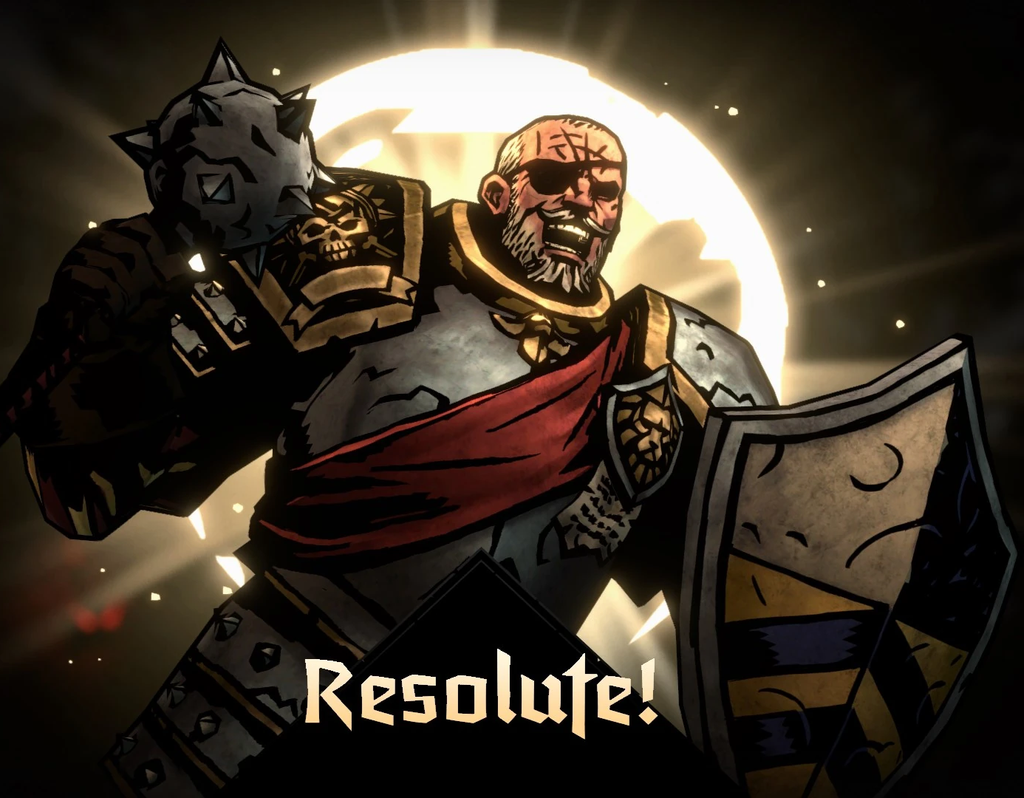
So yes, things can go very badly, but they don’t have to. Once a character’s stress meter reaches ten, they can either experience a meltdown which tanks their HP and relationships with other party members, or they have a one-in-five chance to be resolute which does the opposite; raising their HP and improving their relationship with all allies. There’s another random-but-fun mechanic: relationships. As your band of four heroes travels the world together, certain decisions will increase or decrease affinity. Two characters with low affinity may become suspicious or envious, while high-affinity allies may become respectful or even amorous with each other, gaining negative or positive side effects depending on what they develop. The combination of quirks and relationships helps each character feel unique every run, making thirteen heroes seem more like a hundred.
Screenshot, copyright © Red Hook Studios
Even with all the potential fun-filled power fantasies you can have, there’s always gonna be one or two runs that feel over before they’ve even finished. That’s where the beauty of the game’s primary gameplay loop comes into play. As opposed to the city-building simulator of its predecessor, Darkest Dungeon 2 is a full-blown roguelite. While that does mean a death of your full party results in a blank slate new run, it also means that there’s already an expectation of that failure and less pressure to beat a chapter in a single run. Did your run have a promising start but you only have one hero left with more than halfway to go? You can choose to end at any time and still gain all the rewards you’ve collected up until that point.
Darkest Dungeon 2 uses chapters to tell its story, called confessions. There’s five in total, and you’re free to play through them as many times as you wish. At the end of each run, regardless of if you defeat the final boss or not, you’ll be returned to the Altar where you can spend Candles of Hope you’ve earned through your run. These can be used to buff your characters for future runs, unlock items and even cosmetic options, because who doesn’t love playing dress-up as the world is ending? This addictive and easy-going approach to progression and gameplay is what has led me to rack up almost double the time I spent in the first game over the course of a year in only two months.
If you want a classic, cozy fall feeling, I’m sure there are plenty of games out there to fill that niche. If you’re looking for something different, however, something haunting in time for the most haunted month of them all, then chart a course for the mountain to face your failures and rise above them, above the Darkest Dungeon.